About the color and wavelength of the laser pointer
The laser pointer, also known as the laser pointer, refers to the star-shaped pen. The visible laser is designed to be easy to carry and hand-held, and the laser module (diode) is processed into a pen-shaped transmitter. Common laser pointers include red light (650-660nm), green light (532nm), blue light (445-450nm) and violet light (405nm). Usually reports, courses, guides will use it to project a beam of light or a point object.
Red laser pointer
Laser pointer This is a simple red laser diode. It's just a battery-powered laser diode. In the early 1980s, the first red laser pointer came out and sold for hundreds of dollars. Today, they are much smaller and usually cost less. Diode pumped solid state (DPSS) 671nm red lasers are very common.
Yellow laser pointer
Yellow high power laser pointer on the market are extremely rare. DPSS technology and two lasers with wavelengths of 1064nm and 1342nm are obtained by adding nonlinear crystals. The complexity of the process makes the yellow laser pointer unstable and low efficiency. When the overheating or overcooling mode jump occurs, the output power temperature fluctuates between 1-10mW. That's because the lead wire of the size laser pointer is to provide the required temperature stability and cooling components. In addition, most 593.5nm laser pointers are designed to work in pulse mode, with smaller size and power pump diodes.
Green laser pointer
The trajectory of the 15 mW green laser pointer when exposed from the living room at night.
The Green laser pointer
appeared around 2000 and is the most common type of DPSS laser (also
known as DPSSFD of "Diode Pumped Solid State Frequency Doubler"). They
are more complicated than standard red laser pointers because there are
usually no laser diodes in this wavelength range. Green light is
generated in an indirect process, starting with a high-power (usually
100-300 mW) infrared AlGaAs laser diode operating at 808 nm. 808 nm
optical pumping is a crystal made of neodymium-doped yttrium
orthovanadate (Nd: YVO4) (or Nd: YAG- or less common Nd: YLF), which
lasers deeper in the 1064 nm infrared. Through the electronic transition
in the fluorescent neodymium ion, this laser action is Nd (III), which
is present in all these crystals.
Blue laser pointer
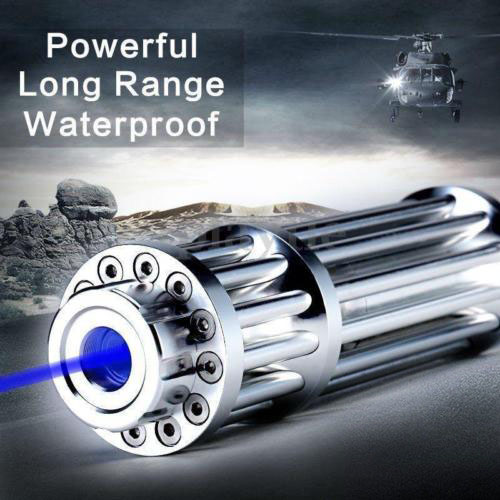
Certain wavelength blue laser pointer, such as 473 nm, usually have the same basic structure as the DPSS green laser. In 2006, many factories began to manufacture blue laser modules for mass storage devices, and these modules were also used for laser pointers. These are DPSS type frequency multiplier devices. They usually emit a beam of 473 nm, which is produced by doubling the frequency of the 946 nm laser radiation from a diode-pumped Nd:YAG or Nd:YVO4 crystal (Nd-doped crystals usually produce a dominant wavelength of 1064 nm, but have The correct reflective coating mirror can also be made into lasers with other "high-order harmonics" non-main neodymium wavelengths). For high output power BBO crystal used as a frequency doubler; for lower power, KTP. The Japanese company Nichia controlled 80% of the blue laser diode market in 2006.


评论
发表评论